
Every AI Must Face Its Judge.
Judging an AI tool is harder than testing ordinary software. MINOS gives your test team a clear, repeatable way to evaluate it, without needing its source code.
The problem
Conventional tests assume a stable right answer. LLM apps rarely have one.
Many valid answers
Outputs are open-ended. Two different responses can both be correct, so exact-match checks miss real failures or flag good answers.
Results change between runs
The same input can produce a different answer, and a different verdict from the evaluator, every time it runs. One run is not evidence.
Judges are not always right
LLM-as-a-judge scales review, but its decisions do not always agree with human experts. A judge that is never checked becomes a hidden risk.
Today, test teams still ask the questions manually and grade the answers by hand.
How it works
- 1Write the caseQuestion, reference and criteria. Every change makes a new revision, the old one stays as it was.
- 2Start the runYou choose the target, the model and the judge. One-off or scheduled.
- 3Answers are collectedThe answer, latency and tool calls come from the assistant’s API.
- 4They are scoredCode checks and an LLM judge assess each metric separately.
- 5You label only what stays uncertainAnswers the machine can’t be sure about come to you. The rest do not.
- 6Labels carry to later runsWhen the same answer comes back, your label is remembered.
- 7Compare with the baselineEvery run appears next to the run you chose as your reference.
The verdict comes from a rule, not an impression.
The judge writes pass, fail or unknown for each metric and attaches its evidence.
The final verdict comes from these results through a deterministic rule.
Without critical evidence the result is not “pass”, it becomes needs_review.
A metric that can’t be measured is not a failure. It is left out.
- Question
- How many days’ notice does the supplier contract require for termination?
- Answer
- 30 days.
- Correctness
- Pass. Matches the reference.
- Grounding
- Unknown. The answer cited no source.
- Verdict
- needs_review. No critical evidence.
Why Minos?
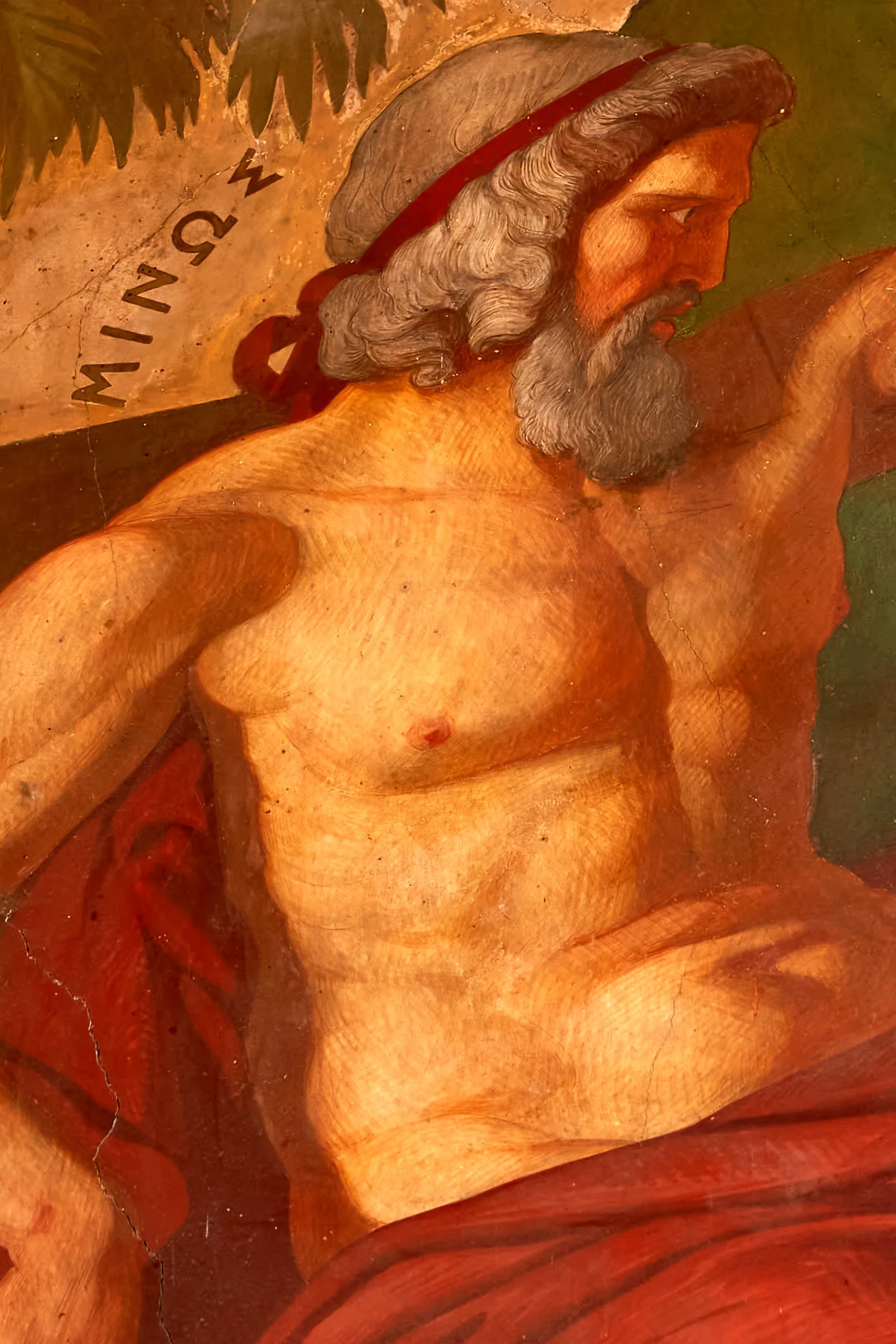
In Plato’s Gorgias, three judges judge the dead. If the other two are in doubt, Minos has the last word. Here too, the rules and the judge speak first. For an answer that stays uncertain, the last word is yours.
You choose how much say the judge has.
Off
The judge does not run.
Suggest
The judge suggests, a person decides.
Auto
The judge’s results go straight into the verdict.
We never need your source code.
MINOS talks to your assistant through its endpoint. Nothing in your code changes, and no code has to be shared.